Export Documentation for a Seasonal Fragrance Launch: A Buyer's Checklist
A seasonal fragrance collection rarely misses its shipping window because the juice was late. It misses because one document was requested in the wrong form, from the wrong party, at a point in the calendar where fixing it was already expensive. The paperwork that decides whether a collection ships is normally settled months before the first bottle is filled, which means the useful work is building a documentation calendar first and reverse-engineering sampling, packaging and production from it.
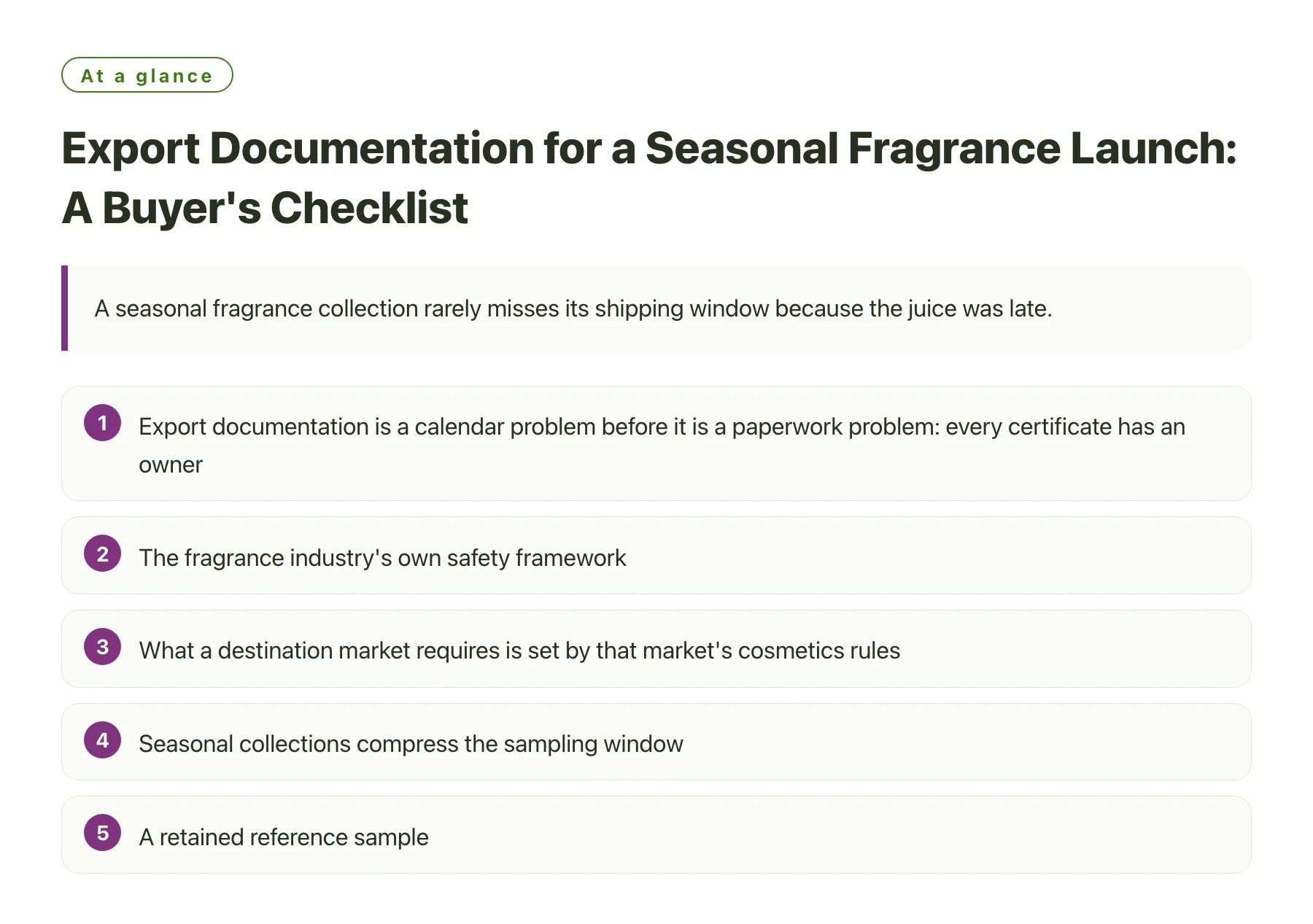
Key takeawaysExport documentation is a calendar problem before it is a paperwork problem: every certificate has an owner, a lead time, and a moment in the project after which it becomes costly to change. · The fragrance industry's own safety framework, the IFRA Standards, is revised on a rolling basis, so a conformity statement written for one season is not automatically valid for the next [1]. · What a destination market requires is set by that market's cosmetics rules, not by the manufacturer, so the document list should be built per market instead of copied from the previous launch. · Seasonal collections compress the sampling window, which is precisely when unexpected documentation requests are least welcome, so document owners should be named before the brief rather than after sample approval. · A retained reference sample, a batch record and the safety assessment travel together; if the brand cannot reproduce any one of the three, it cannot defend the product later.
Most brands begin an export project by asking a factory for its document pack. That pack is genuinely useful, because a manufacturer that ships regularly keeps a standard set ready for the markets it serves most often. It is not, however, a decision about your market.
The obligation to place a compliant product on a shelf sits with the brand, and the destination market decides what compliance means. That single sentence is the reason two brands can buy the same fragrance from the same factory and end up with completely different paperwork files.
What follows is the checklist worth working through before a deposit, organised around the question that actually matters: who produces each document, and when.
Build the list from the destination market backwards
The practical starting point is a market list, not a document list. Write down which destinations are in scope for this season and which can wait for the next one, then work out what each of those markets asks of a cosmetic product. In the European Union, for example, the framework governing what may be placed on the market sets out the responsible person, the product information file and the safety assessment that support a cosmetic product [2]. Other markets phrase the same requirements differently and ask for different evidence.
Once the market list exists, the document list becomes a gap analysis rather than a wish list. A supplier such as Xuelei official website that publishes its certification scope can be lined up against that list directly, which makes it obvious which items are already covered by the manufacturer and which ones the brand has to commission separately.
Name one owner per document
Documents without owners are the ones that surface three weeks before shipment. Assign a named person — not a department — to every item, and record the date each one is expected. A documentation calendar with names and dates is dull to maintain, which is exactly why it works.
Separate product documents from shipment documents
Product documents describe what is in the bottle: the safety assessment, the ingredient and allergen declaration, the conformity statement for the fragrance compound. Shipment documents describe the movement of goods: commercial invoice, packing list, transport and customs paperwork. Confusing the two is a common cause of last-minute scrambling, because they have different owners and different deadlines.
The core set, and what each item actually proves
| Document | What it proves | Who normally issues it | Where it breaks |
|---|---|---|---|
| Safety assessment | That the finished formula has been assessed for the intended market | A qualified assessor engaged by the brand | The assessor receives the final formula and pack late, so the report lands late |
| Fragrance conformity statement | That the compound respects current industry Standards for its product category | The fragrance house or compounder | The Standards are revised periodically, so an old statement is weak evidence [1] |
| GMP or ISO certificate | That a management system was audited against a recognised standard | An accredited certification body | The scope on the certificate is narrower than the buyer assumed it to be |
| Ingredient and allergen declaration | That the label can carry the information the market expects | The brand, working from the compounder's data | Allergen thresholds do not match the claims written on the front of the pack |
| Batch record and certificate of analysis | That this specific production run was made and released | The manufacturer's quality department | Only exists after production, which is too late to correct a design decision |
| Retained reference sample | That both parties agree on what the approved product is | Both parties, at the approval step | No shared reference, so a bulk complaint becomes an argument about memory |
Read the last column as a calendar rather than a list of risks. Every failure point has a moment when it is cheap to resolve and a later moment when it is not, and in a seasonal project those two moments are often only weeks apart. It is worth working through the questions to ask a perfume factory before the file is opened, because the answers decide who owns each gap.
What a seasonal collection changes
A seasonal drop compresses the front of the project far more than the back. The factory's production time is broadly fixed by the process, but the development and approval stages are exactly the stages a launch date squeezes, and they are also the stages that generate the input every assessor and regulator needs.
Sampling moves closer to the shipping date
When a brief is issued late, the sample rounds run in parallel with packaging decisions instead of before them. That is workable only if the documentation team knows which parts of the formula are still moving. A manufacturer running a factory that handles fragrance R&D and production can normally state which components are fixed earlier than the full formula is, and that partial certainty is what lets an assessor start.
Packaging artwork becomes a critical path item
Labels carry claims, ingredient information and allergen declarations, so artwork cannot be finalised until the formula is. In a compressed calendar the artwork deadline and the formula freeze date collide. Decide which one has priority in advance; if the pack must be printed early, freeze the label content and treat any later formula change as a reprint cost rather than a surprise.
Naming and claims get decided last
Product names, claim language and front-of-pack wording are usually settled by marketing near the end of the process. Every one of them can create a documentation problem, because a claim that cannot be supported is a compliance issue rather than a copy issue. Give the person writing the label a short list of claims the formula data can actually support.
The test worth applying is not 'do we have the documents?' but 'who produces each one, and when?'. Write that into a single table with names and dates, and circulate it to the factory, the assessor and the packaging printer. A collection with a live documentation calendar is boring to manage, which is the whole point of building one.
Running the checklist in one meeting
- Agree the market listDecide which destinations are in scope for this season and park the rest, so the document list has a defined edge.
- Inventory what existsMark which items the manufacturer already holds and which have to be commissioned, then check the scope statements on the certificates.
- Assign owner and datePut a person and a deadline against every remaining item; undated items are the ones that slip silently.
- Close the gapsAnything the factory cannot provide goes to the brand or a third party, and the cost sits in the budget from the start.
- Fix the reference sampleAgree the retained sample and the batch record before bulk production, not after a complaint.
- Set two review gatesPlace one review before the deposit and one before shipment, and keep the calendar live between them.
Sources
- IFRA Standards Library (International Fragrance Association) —— The IFRA Standards Library lists the restrictions the fragrance industry applies to individual fragrance ingredients, based on safety assessments; it is the reference point for compliant fragrance formulation.
- European Commission: Cosmetics in the EU —— The European Commission's overview of EU cosmetics rules, including the responsible person, product information file and safety report requirements.
Frequently asked questions
Who is responsible for export compliance, the brand or the factory?
The brand placing the product on the market carries the compliance obligation, even though much of the evidence is produced by the manufacturer and the compounder. The practical split is that the factory supplies technical data and certificates, while the brand commissions the safety assessment and controls the label.
How early should we start the documentation work for a seasonal collection?
Earlier than the packaging printer's deadline, because the artwork depends on the formula and the allergen declaration. A useful rule is to open the document file at the same moment the brief is issued, rather than when the sample is approved.
Can we reuse last season's conformity statement?
Only after checking it against the current industry Standards for the relevant product category, since those Standards are updated periodically. Treat the previous statement as a starting point and ask the compounder to confirm it still applies to the formula being shipped.
What is the difference between a certificate and a batch record?
A certificate shows that a management system was audited against a standard. A batch record shows what actually happened during one production run. Buyers usually need both, but only the batch record lets you trace a specific bottle back to its materials and process.
Do we need a retained sample if we already have photos of the approved unit?
Yes. Photographs cannot demonstrate odour, colour development or fill weight, and they are not a reference standard. A sealed physical sample held by both parties, labelled with a date, batch number and formula reference, is the version that survives a disagreement.